
Evolution of Data Analysis
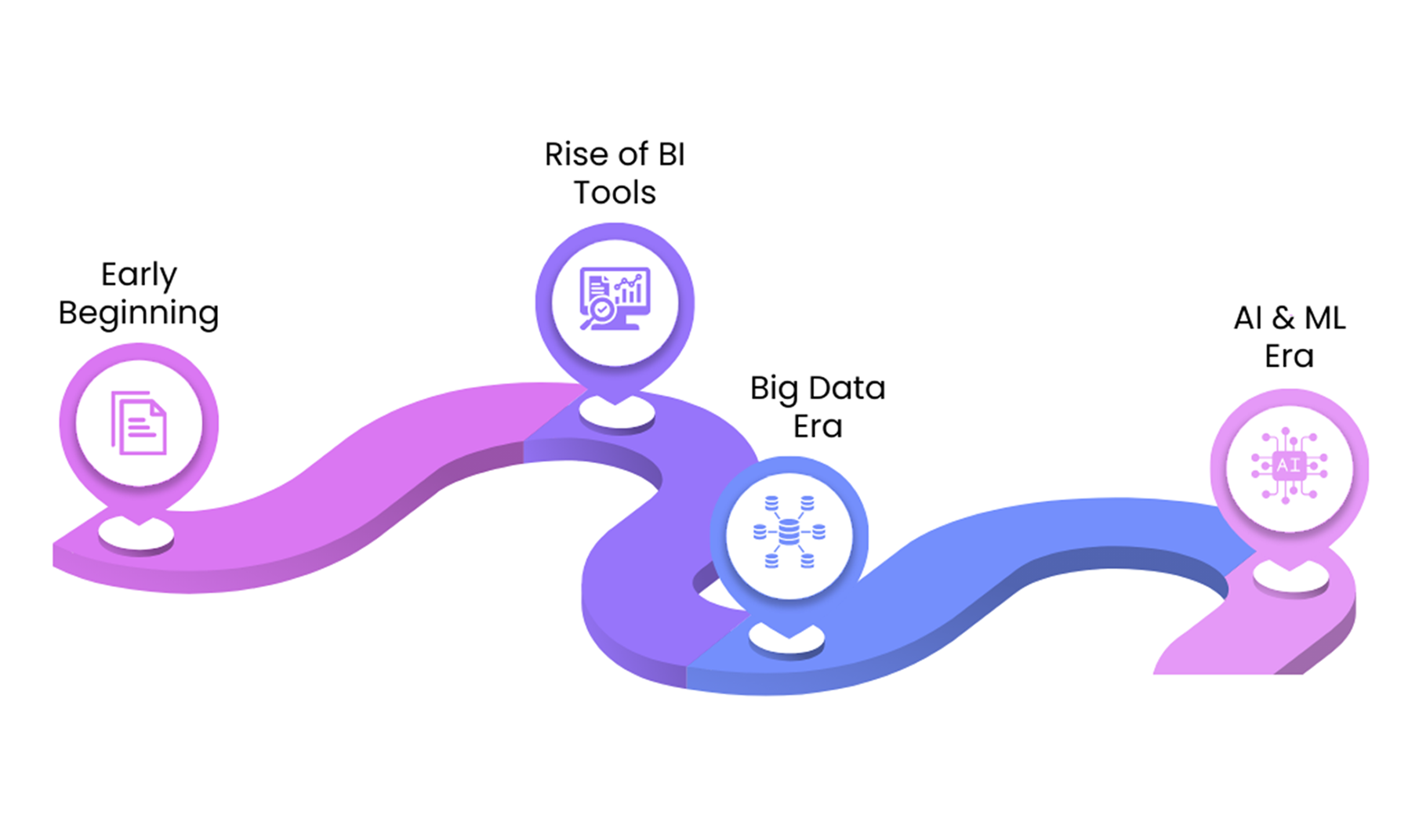
Early Beginnings
With the advent of digital computing in the 1950s, the era of manual data analysis transitioned to automated processes. Relational databases and statistical tools allowed large-scale data organization and retrieval, setting the foundation for modern analytics. Key milestones included the development of mainframe computers and the initial implementation of programming languages for data processing.
Rise of BI Tools
The 1990s and early 2000s saw the emergence of Business Intelligence (BI) tools. Organizations increasingly relied on data warehousing to consolidate structured data, while tools like SQL, Excel, and early visualization platforms became essential for reporting and analysis. These advancements enabled businesses to extract actionable insights from historical data, improving decision-making processes.
Era of Big Data
The 2000s to 2010s marked the explosion of data volumes due to the growth of the internet, social media, IoT, and mobile technologies. This era demanded innovative solutions for processing unstructured and semi-structured data at scale. Technologies like Hadoop, Spark, and NoSQL databases enabled distributed computing and storage, while predictive analytics became integral for forecasting trends and behaviours.
Era of AI and ML
From the 2020s onward, the rise of artificial intelligence (AI) with machine learning (ML) has revolutionized data analytics. Advanced technologies such as deep learning, neural networks, and natural language processing allowed for real-time insights, automation, and prescriptive analytics.
These tools have transformed industries, with applications in personalized healthcare, fraud detection, autonomous systems, and more, showcasing the power of AI-driven analytics.
Significance of Data Analysis in Modern Day Business
Data Analysis empowers organizations to derive strategic insights, aiding in the formulation and refinement of business strategies to stay competitive. Data Analysis plays a crucial role in risk assessment, helping businesses identify potential challenges and develop proactive strategies to mitigate risks.
Through data analysis, organizations optimize operational processes, streamline workflows, and enhance overall efficiency. Informed decision-making based on data ensures optimal allocation and utilization of resources, maximizing productivity.
In the next section, we will understand the different types of data analysis with some business examples.