
Big Data
Big Data refers to extremely large and complex datasets that are hard to process using traditional tools. These datasets grow quickly and come from various sources. Big Data is generated from multiple sources like,
-
Social media platforms via posts, reviews, and user interactions
-
IoT devices that constantly create data streams like sensors, and fitness trackers.
-
Online purchases, financial transactions, and billing systems.
-
Multimedia content, such as videos, audio recordings, and images that create unstructured data.
-
System logs from apps, servers, and networks which potentially offers insights for monitoring and improving operations.
These sources give businesses the data they need to make better decisions and drive innovation.
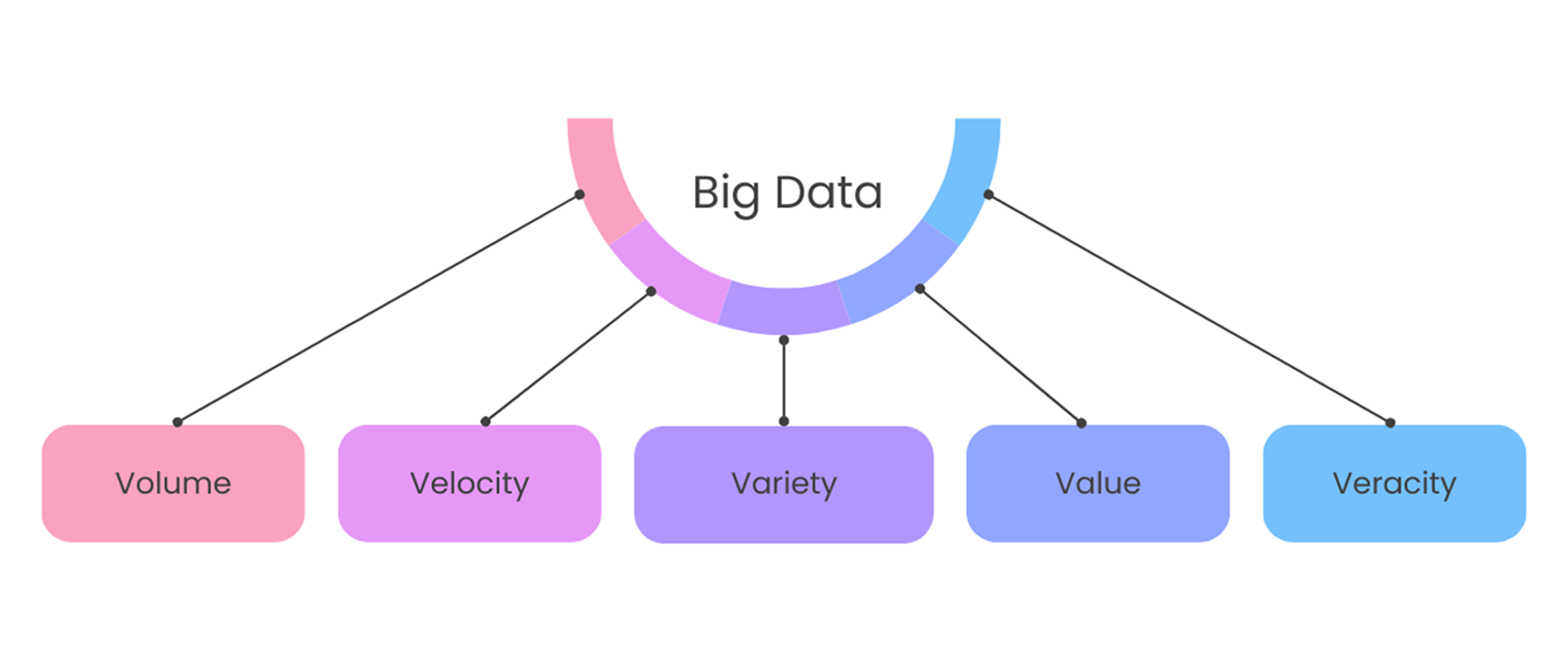
Big Data is defined by five key characteristics:
-
Volume: Refers to the enormous quantity of data produced daily from different sources, such as social media platforms, IoT devices, sensors, and transactional systems.
-
Velocity: Refers to the rapid pace at which data is generated, processed, and analyzed, often in real time or close to real time.
-
Variety: Indicates the wide range of data formats, including structured data (like databases), semi-structured data (such as JSON and XML), and unstructured data (like videos, images, and text).
-
Veracity: Emphasizes the accuracy and reliability of data, tackling issues like inconsistencies, errors, or incomplete information.
-
Value: Highlights the need to derive meaningful insights from Big Data to support better decision-making and business growth.
Big Data helps businesses make better decisions, improve customer experiences, and enhance efficiency. For example, analysing customer behaviour allows companies to create personalized marketing strategies. Operational processes can also become more efficient by identifying bottlenecks and optimizing workflows.
Now that we understand about Datasources, the next step is to learn how businesses process this data. Processing can happen in real-time, in batches, or using a hybrid approach, depending on the business need. In the next section, we will explore these approaches and how they help businesses manage and use data effectively.