
Data Normal Forms
Data normalization is the process of organizing data to reduce duplication and ensure consistency. It involves splitting data into smaller tables and defining relationships between them. These levels of data organization, called normal forms, play a key role in how data warehouses are designed and how quickly they can process queries.
A normalized data warehouse uses a structure with many smaller, related tables, like in the Snowflake schema (which will be covered in the subsequent section). This design reduces duplication and ensures consistent data. It also uses less storage space, but querying can be slower because it requires joining multiple tables. A normalized design works best for businesses prioritizing data integrity and frequent updates.
In contrast, a denormalized data warehouse, like in the Star schema, combines related data into fewer, larger tables. This setup makes querying faster and easier to understand, especially for reporting and analysis. However, it requires more storage space and may lead to some data duplication. A denormalized data structure is ideal for businesses focused on quick, user-friendly access to data for analytics.
What Are Data Normal Forms?
Normal forms are rules that structure data tables to improve efficiency and accuracy. The most used normal forms are:
-
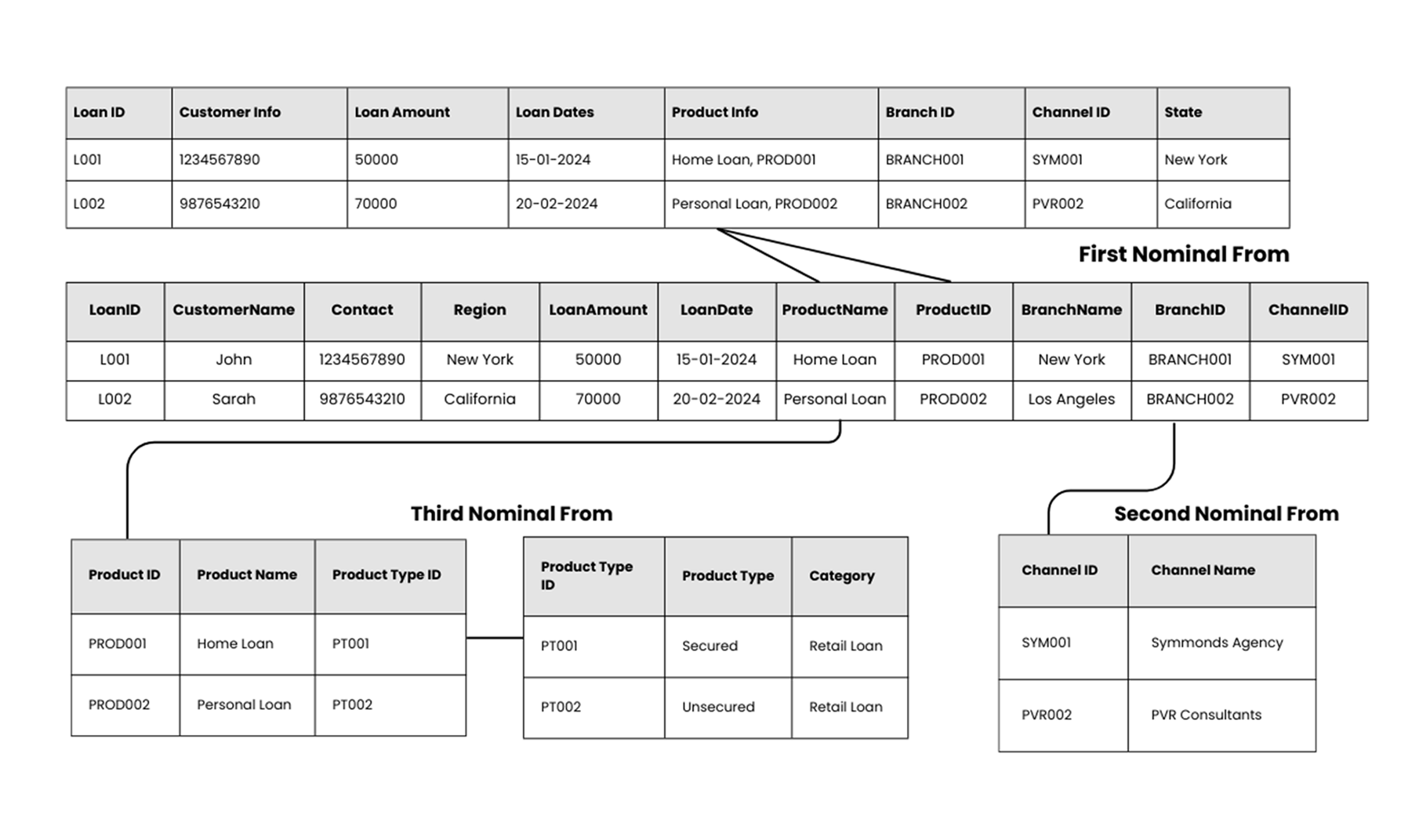
First Normal Form (1NF) ensures that each column has only single, simple values. For example, instead of listing Product Info as a combination field, you will separate it out into 2 columns – Product Id and Product Name.
-
Second Normal Form (2NF) builds on the 1NF by ensuring that every non-key column depends entirely on the primary key. For example, if a table mixes Channel details and Product details, you will split them into separate tables for Channel and Product.
-
Third Normal Form (3NF) ensures that non-key columns depend only on the primary key and not on other non-key columns. For example, if a table contains Customer Name, Customer ID, and Region, you will move Region to a separate table to avoid dependence on Customer Name.
How Data Normalization Impacts Query Performance
Normalized structures provide better data accuracy but can slow down query performance because they require multiple joins to retrieve information. They are most useful for systems that frequently update or manage complex data relationships.
Denormalized structures, on the other hand, improve query performance because they reduce the need for joins. This makes them ideal for reporting tools, dashboards, and other systems that prioritize speed and ease of use over strict data accuracy.
While normalization ensures data consistency, some dimensional data can change over time, like, customer addresses or product categories. Slowly Changing Dimensions (SCD) help track these changes without losing historical data. In the next few sections, we will understand Facts and Dimension tables, explore the different types of SCDs and how they manage these changes.