
SCD (Slowly Changing Dimensions)
Slowly Changing Dimensions (SCD) are methods used in data warehouses to manage changes in data that happen slowly over time. For example, dimension tables store descriptive details like customer names, product categories, or employee roles, which can gradually change over time. SCD ensures these changes are managed effectively, preserving historical information and enabling accurate trend analysis.
There are different types of SCDs, each suited for specific scenarios:
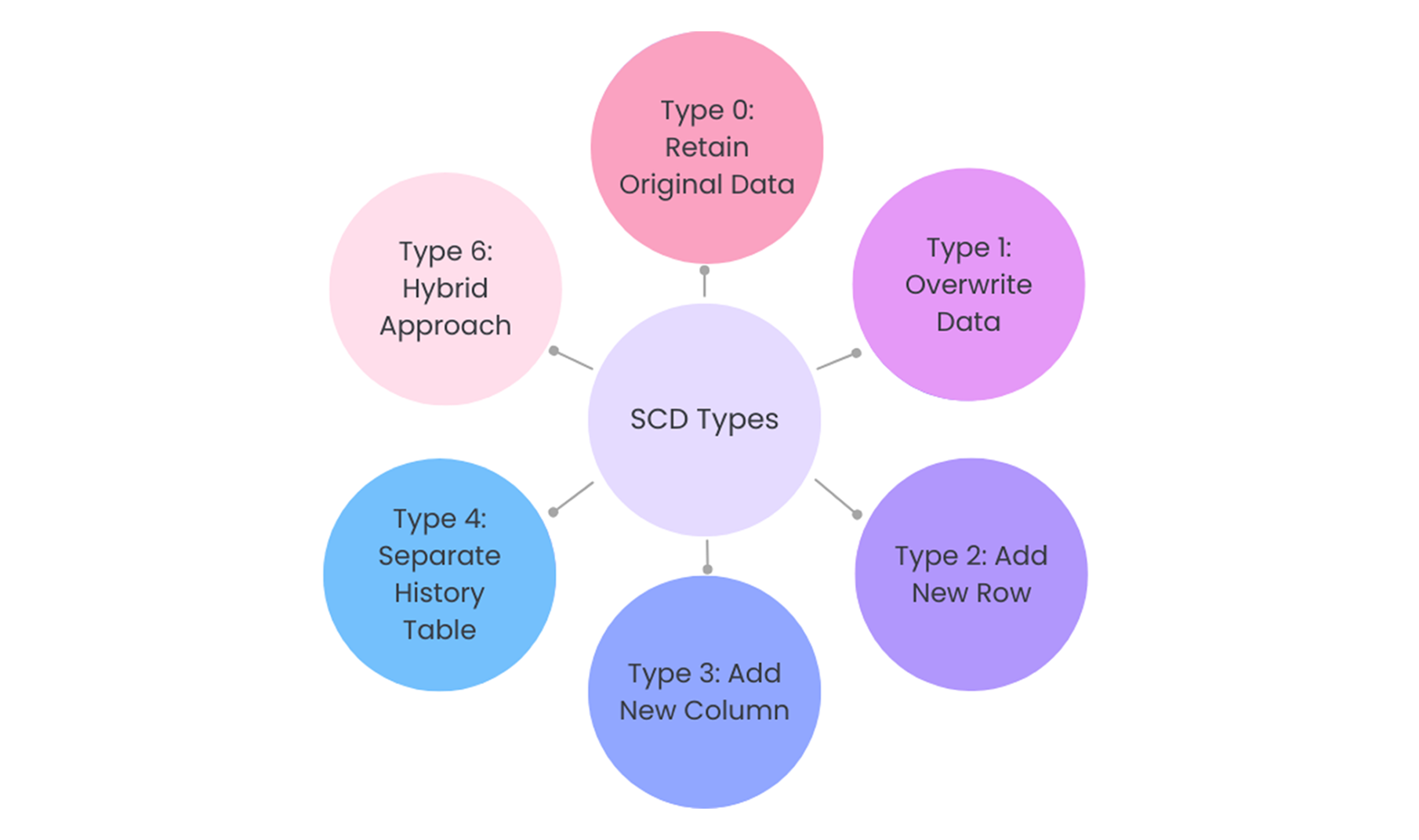
SCD Type 0: Retain Original Data
In Type 0, no changes are made to the original data, even when updates occur.
Example
| Customer ID | Name | Address |
|---|---|---|
| 1 | Alice | New York |
- Even if Alice moves to Boston, the table still shows her address as New York.
- Use Case: Historical consistency is prioritized, and updates are ignored.
SCD Type 1: Overwrite Data
In Type 1, old data is replaced with new data, and no history is preserved.
Before Update:
| Customer ID | Name | Address |
|---|---|---|
| 1 | Alice | New York |
After Update (Alice moves to Boston):
| Customer ID | Name | Address |
|---|---|---|
| 1 | Alice | New York |
- Use Case: Only current data matters, such as updating product prices or customer details.
SCD Type 2: Add New Row
In Type 2, a new row is added for every change, and the original data is retained with a history of changes.
Before Update:
| Customer ID | Name | Address | Start Date | End Date |
|---|---|---|---|---|
| 1 | Alice | New York | 2023-01-01 | NULL |
After Update (Alice moves to Boston):
| Customer ID | Name | Address | Start Date | End Date |
|---|---|---|---|---|
| 1 | Alice | New York | 2023-01-01 | 2023-06-30 |
| 1 | Alice | Boston | 2023-07-01 | NULL |
- Use Case: Track a complete history of changes, such as customer address history or employee roles.
SCD Type 3: Add New Column
In Type 3, a new column is added to store the previous value while keeping the current value.
Example Table
| Customer ID | Name | Current Address | Previous Address |
|---|---|---|---|
| 1 | Alice | Boston | New York |
After Update (Alice moves to London from Boston):
| Customer ID | Name | Current Address | Previous Address |
|---|---|---|---|
| 1 | Alice | London | Boston |
- If Alice moves again, the current address updates, and the previous address becomes Boston.
- Use Case: Track the most recent change without maintaining a full history.
SCD Type 4: Separate History Table
In Type 4, the main table stores only the current data, while a separate table records all historical changes.
Main Table (Current Data):
| Customer ID | Name | Current Address |
|---|---|---|
| 1 | Alice | Boston |
History Table:
| Customer ID | Address | Start Date | End Date |
|---|---|---|---|
| 1 | New York | 2023-01-01 | 2023-06-30 |
| 1 | Boston | 2023-07-01 | NULL |
- Use Case: Useful when the main table should remain lightweight, and detailed history is kept in a separate table.
SCD Type 6: Hybrid Approach
Type 6 combines elements of Types 1, 2, and 3. It stores the current value, a previous value column, and maintains full historical rows.
Example Table:
| CustomerID | Name | Current Address | Previous Address | StartDate | End Date |
|---|---|---|---|---|---|
| 1 | Alice | Boston | New York | 2023-07-01 | NULL |
After Update (Alice moves to London from Boston ):
| Customer ID | Name | Current Address | Previous Address | Start Date | End Date |
|---|---|---|---|---|---|
| 1 | Alice | London | Boston | 2024-01-01 | NULL |
| 1 | Alice | Boston | New York | 2023-07-01 | 2023-12-31 |
| 1 | Alice | New York | NULL | 2023-01-01 | 2023-06-30 |
- Use Case: Ideal for scenarios requiring a mix of current state, recent changes, and full historical tracking.
In the next section, we will look at stage tables, which are used to temporarily store, clean, and transform raw data before loading it into the DWH (fact or dimension tables). Stage tables act as a temporary area to handle raw or intermediate data before it moves into the main DWH.